
What follows is the result of an idea aimed at connecting the realm of philosophy and thought with the world of drama. The idea is to select sentences from the statements of the members of the philosophical group, archived in the “Chistiha Blog”, and after working on the concepts of those discourses, along with some brief practice and editing, create a dramatic idea. In its continuation, another dialogue, another concept, and another thought would take shape.
In the principles of screenwriting, “idea generation” and “plot outlining” have specific methods; however, we tried to be one step before the idea and the plot. In that very stage of the mental spark — or, as we call it, the “étude” stage — where the writer’s hand is free to put into writing any image, imagination, imagery, or witty remark. Here, we did not limit ourselves by avoiding mention of technical instructions, executive arrangements, dialogue, scene construction, and other such matters, leaving them for more detailed outlines. On the contrary, we have fully written down everything that came to mind in the moment.
Through our group sessions, we reached the conclusion that there is no need for polished and precise outlines of our conversations. It was only necessary that whatever came to mind in a single instant be immediately edited and recorded under the title “Étude.”
And now we share the same with you. May these exercises and études be the beginning of a path for stepping onto the bridge between philosophy and drama.
Ideas on the Bridge from Philosophy to Drama: Étude One Hundred and Twenty-Sixth
Note: These études have been registered with the Ministry of Culture and Islamic Guidance. Their intellectual property belongs to the author. These études are only permitted to be republished on the “Chistiha” website.
Idea Number One Hundred and Twenty-Sixth
Étude 126
Stage Play Real time span of events: Twenty years Geographical region of events: Afghanistan, Iran, United States
A certain amount of this story’s pattern can be similar to the novel Memoirs of a Geisha.
A woman stands facing us. As the lights come up, she is seen staring fixedly at us. We name her Ramsha. But throughout this play, she has no name.
She says: “I” — and that is her entire sentence. Complete silence and pause. Some time passes and the stage goes dark so that the next various scenes can unfold. This will be repeated in the intervals between these scenes, and we see that the woman is simply standing facing us and saying: “I.” And that’s all. Of course, each time something changes in her appearance. This scene is completely empty.
The story is about Talibanism. The arrangement of the scenes is such that we have a recurring scene from the U.S. Central Intelligence Agency. It consists only of a series of devices and hard drives of the organization’s supercomputers, whose lights are constantly blinking — meaning they are working. In these scenes, only a few American employees occasionally come, sit down, listen, focus on monitors or other things, and leave. This scene will be repeated like a motif at intervals to suggest that everything that exists is orchestrated by American intelligence and identification systems. A place that will be accused of all the wars in the Middle East being under its control.
In the first scenes, which relate to present-day Afghanistan, we see the same woman we know — Ramsha — how active she is in collecting financial aid and promoting Taliban ideology among women. She wants to hold a conference for them to attend and be the voice of Taliban women. All the women in this scene wear burqas and black gloves. They are all dressed entirely in black. Although here, in this gathering, there are no men.
Then we go to the past of this same woman. Scenes from the Taliban wars of twenty years ago, in which the brothers and father of this little girl (Ramsha) are also present. What allows us to recognize this little girl is not her name, but an object kept as a memento from her father, which we have previously seen in her hand. It is an RPG shell casing. It was given to Ramsha in childhood, at the time of her father’s peak power. We had previously seen this memento when adult Ramsha showed it to her friends as her father’s only keepsake.
Then the story of the killing of each of these brothers in subsequent scenes, and the father’s injury that left him paralyzed from the waist down, with the mother caring for him all these years. The mother, this woman, says nothing at home. A meager and lowly life. And at the end, the father dies.
It is after this father’s death that Ramsha came to Iran along with her cousin, “Ekhtiar,” who has now been her husband for several years. Both are in their early twenties. In Iran, these two undergo changes. Ekhtiar, who had always been opposed to the Taliban but never said anything, now works as a laborer in one of the cities south of Tehran (perhaps Islamshahr). He has brought Ramsha with him with great difficulty and illegally. Now he reveals his secret: that he never believed in the Taliban group and even hated them. This is somewhat heavy for Ramsha, who is promoting the same ideology among a few Afghans in this region of southern Tehran. She becomes upset and resentful toward her husband. Their argument escalates. And it is precisely these conflicts that lead, in one moment, to Ekhtiar deciding to kill Ramsha while she is asleep. But today, because Ramsha had gone to promote her cause to one of these Afghan women in Islamshahr and had drunk some Turkish coffee — as they wanted to read her fortune — and they had predicted that “stormy events will be written for you.” But Ramsha had said she doesn’t believe in such things and only drank the coffee out of respect, and of course it was also tasty. Now that she has returned, she cannot sleep until four in the morning. Late at night, when Ekhtiar comes home around midnight and wants to carry out his intention, Ramsha is awake. She notices the knife in her husband’s hands and escapes with a scream.
In the following scenes, Ramsha is with her friends in America. She is recounting the story of that night — how she fled the house barefoot and hid for two days behind barrels full of garbage belonging to a garbage collector in the darkness of the night. The stench had permeated her entire body. And how a woman becomes her savior — a woman who, while going to empty garbage from her car into the dumpster, found Ramsha there.
We do not know what events led the woman to bring Ramsha to America, nor exactly what transformations that woman caused in Ramsha’s spirit. Her surname could be “Tavangar” (Wealthy/Powerful). In any case, it was Mrs. Tavangar who brought Ramsha to America illegally and arranged work for her. All we know is that Mrs. Tavangar cooperates with ISP services and the sale of various filters and VPNs. She is also a programmer herself. That day, she had gone to Islamshahr as a translator to cooperate with a truck manufacturing company, most of which belongs to a Chinese company. On her way back, she found Ramsha among the garbage.
In any case, today Ramsha is working in America. In the intervals when she comes on stage each time and in silence only says “I,” her clothes have changed — from those of an Afghan woman to an Iranian woman, and now she has become an American woman. But interestingly, all these clothes are somehow similar in length and color: from black to dark, and then to a bruised purple — a similar color palette in the dark gray spectrum.
We see Ramsha’s small, dark apartment in America. Her only means of communication is a mobile phone. She has nothing else. But apparently she should be content with working in a conference hall — cleaning work. She is a janitor.
We see the conference hall, which is empty. By chance, Ramsha, who is dusting, washing, and cleaning the floor, walls, tables, and podiums of the hall. Today is Eid al-Adha. Ramsha is listening to Afghan music on her mobile with earphones. Mrs. Tavangar suddenly enters the hall. Ramsha happily goes toward her. They both come up onto the stage where the podiums are. Mrs. Tavangar wants to hear what Ramsha is listening to. Ramsha removes her earphones, and now the sound of Afghan music fills the hall — about Abraham and his faith.
It is in this scene that Ramsha pours out her heart. The conversation turns to clothing. That a woman’s essence is essentially defined by her clothing. And how much she wished that none of these clothes had ever been on her body throughout her entire life. She finds none of them worthy of her true personality. There is a painting in the hall that we had seen Ramsha staring at. It is a copy of the famous oil painting called La Anunciación by Pedro Berruguete. Ramsha tells Mrs. Tavangar that the only clothing that seems worthy of a woman in her opinion is this one. She can stare at this painting for hours. Its subject apparently is: The Woman Who Said Yes to God, and this is the only clothing worthy of a woman. In this conversation, there is also a reference to Descartes in Mrs. Tavangar’s words — that unfortunately intelligence services do not allow the concept of freedom to turn into the taste of freedom and be experienced. That is why the best means is this very clothing — whether the burqa of an Eastern Muslim woman or this lack of restraint in the West.
And at the end, again after a short pause and interval, in the final scene the same empty scene is repeated. This time, at the end, Ramsha, facing us the audience, says: “I… am.” And this “I am” should recall Descartes’ cogito. In this ending, the RPG shell casing is in Ramsha’s hands like a crystal ball of prophecy, which she has taken out from under the fabric of her clothing.
Writer: B. Khosravani
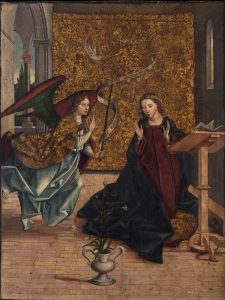
Picture of the BERRUGUETE_antes_restoracion-en-tamano-grande board
It is reminded that any copying or adaptation of these ideas, from an ethical and legal standpoint, is only possible with mention of the source, and using them for production is only possible upon obtaining the written consent of the author.
Contact with the author: via Instagram (@pol.educational.group)