
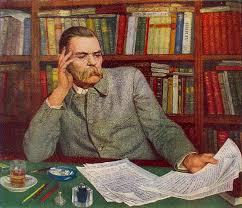
Along with Maxim Gorky: A Look at the Purpose of Literature
Masoumeh Bouzari
“Once among us there were great orators and individuals who had grasped the secrets of life and the human soul.”
“The Purpose of Literature” by Maxim Gorky is a highly literary text in a fictional form, yet entirely composed of theory and criticism. Through the juxtaposition of beautiful metaphorical images alongside precise meanings, it seeks to offer the reader a questioning perspective on the purpose of literature and the relationship between writer and reader. Maxim Gorky, the renowned figure of Russian and world literature, begins this imaginative and story-like work with a conversation between a somewhat arrogant writer and an unknown person representing the readers of his works. He then advances the discussion around the nature of literature and the social dimensions of a literary text with extremely meticulous critique and theory.
“The Purpose of Literature” apparently results from a marvelous conversation that begins in a dreamlike and highly ambiguous space. Yet in reality, it is precisely this ambiguity of the situation that best arouses the reader’s sense of curiosity and inquiry. As the story progresses, through the codes Gorky provides for deciphering his narrative, we realize that this unknown person is none other than the writer’s own conscience. As time passes, the veils of ambiguity and darkness are lifted, until at the end we find ourselves in a luminous space filled with the rays of the world-illuminating sun. This symbolic enlightenment and illumination is both the general purpose of literature and, at the same time, Gorky’s specific purpose in this story-like piece.
This story views literature as a sublime reality that transcends all ideological narrow-mindedness. Although we know Gorky’s particular political outlook, in this text he fully reminds us of the sanctity of the realm of literature. At the same time, he compels us to reflect on the most basic and fundamental truths and to ask ourselves: “What truly is the purpose of literature? And what explanation can be given for the writer’s motivation and the reader’s need?” In this reflection and self-examination, Gorky places himself in the position of a literary writer — indeed, precisely himself — who is confronted with strange questions from that awakened conscience.
The fact that Gorky, in a text of approximately ten to twelve pages titled “The Purpose of Literature,” employs every literary device (personification, allegory, allusion, simile, metaphor, symbol, code, and so on) to speak about the nature of literature is solely so that form and meaning become one. In this way, he teaches his reader — who may perhaps dream of becoming a writer — how to shape form in harmony with content and thought. This story-like form, with its symbolic and coded imagery that is appropriate and consistent with the questions and answers of these two wayfarers, causes us, while immersed in an imaginary world, to arrive at a critical way of thinking and an honest view of the nature and motivation behind literary writers’ imagination.
Gorky’s characterization in this work entirely returns to symbols and archetypes with which we are familiar: “The awakened and thoughtful shadow confronting the tired, sleepy, and arrogant hero.” This method of creating characters from abstractions has been one of the oldest techniques in allegorical stories across all nations. The purpose of manifesting such pure imagination is solely to confront man with truths from another world — or rather, from within himself. Just as “Reason” appears in Suhrawardi’s treatise The Red Intellect, “Satan” in Marlowe’s play Doctor Faustus, and “Death” in Bergman’s film The Seventh Seal, all of them drive us to explore the hero’s soul so that, through empathy with him, we may hope for our own purification and elevation.
“Symbolization is the inspiration for all psychic manifestations of man and relates to all branches of human knowledge.” (Sattari, 1374, article on Symbolism by Dr. René Fauré and Dr. René Allendy)
The use of first-person point of view and simple past tense — as seen in Gorky’s other works (The Warden, Twenty-Six and One, Fragments from My Diary, etc.) — brings us closer to the writer and makes us believe his thoughts. In this text as well, from the very beginning, the story’s setting emphasizes the necessity of “self-knowledge”: that the writer must first confront himself to understand what the people and his audience need. It also stresses the requirement that he must face the Other with complete honesty and, only without lies or hypocrisy, will he be able to stand alone against that awakened, aware, and critical conscience. In this essential search for the writer’s critical self-knowledge and the discovery of his inner motivations, Gorky subjects none more than himself to criticism. Just as his close friend, the physician Anton Chekhov, usually challenges the performance of doctors in society in his short stories — and even portrays the army doctor Chebutykin in the play Three Sisters as an extremely superficial, lazy, and unstudied character. Or Leon Tolstoy, Gorky’s other close friend, who devoted his entire life to literature and art; in addition to his book My Confession, in which he examines his inner faith, in What Is Art? he implicitly begins with the question that if we look at the exhausting work of those who organize a musical performance, ballet, or official theater, we become so astonished that we ask ourselves: what need is there for art at all, such that in a large part of life, some people spend their years acquiring artistic knowledge and cultural activities, while others spend their lives observing their work. This critical and self-examining outlook was the foundation for the creativity of such writers.
In this text, the unknown person tells the writer: “A noble teacher must always be a precise student.” Thus, we realize that if a committed writer is successful in creating situations and characters in his stories, it is because he exists in a two-way, deeply understanding, contractual, and semiotic bond with his society. He has the power to understand pains and draws his information from a chain dependent on others and their crises. He then best compiles it in his world of imagination so that, by depicting similar situations, he can offer a comprehensive solution. “From Freud’s point of view, the dream is as much ‘manifest content’ as it is ‘latent content.’ The dream is the functional unity of two components… In Sartre’s specific criticism, the signified is the product of the initial crisis of the object; literature shapes speech as the signifier; and it determines the relationship between crisis and the work of speech, which is a signification.” (Barthes, p. 33)
Such a lasting signification and clear, limpid reflection of realities and social crises shines beautifully in Gorky’s literary works, even though his realism is not like an instant photograph of reality; rather, it is more constructed and elaborated by his alert mind.
“The literary work, as a historical allegory, reflects the social data of its era — that is, the historical events, mental preoccupations and obsessions, tensions, and conflicts of the social structure of that time.” (Sattari, 1374, p. 123, article on Literature and Myth by Northrop Frye)
Therefore, in examining the text “The Purpose of Literature,” we inevitably must pay attention to the character of Maxim Gorky in his own historical context and recall many realities of Russia before and after 1905. These include: functionalist perspectives, Russian formalism, the widespread publication of historical and realist novels, questions about the God-seeking mind and the purpose of life, the movement of the masses instead of bourgeois sedentary life, the historical-social justification of all economic and cultural activities, and above all, the beginning of new literary movements and Marxist criticism. This approach can be the most suitable type of criticism for examining the text “The Purpose of Literature.”
In his book Contemporary Literary Criticism Theories, regarding Marxist criticism, Lois Tyson says: “The ‘mode of operation’ or Marxist methodology dictates that the value of theoretical opinions should be measured solely on the basis of their practical application — that is, purely in terms of their effectiveness in the real world… Marxist theory remains a valuable method for understanding history and current events. In fact, Marxism can even be used to interpret the failure of Marxist regimes.” (Tyson, 1387, pp. 96–97)
What Maxim Gorky does in literature is similar to this very theory. In fact, the publication of his works began after the uprisings of 1905, and from the heart of socialist thought he moves to confront the existing fissures in his society. Gorky rose from the lower class and, until the end of his life — even after achieving world fame — remained preoccupied with the concerns of this class in his society. That is why he only goes along with the socialism of his time as far as he himself truly believes in it. To understand his works, we inevitably need to examine the public opinions of his era.
“The fact that literature arises from material or historical conditions and at the same time reflects them can at least attract the attention of Marxist critics from two directions: 1) A literary work can reinforce ideologies in the reader, or 2) A literary work can lead the reader to criticize the ideologies it represents. If content is the ‘what’ of literature, then form is its ‘how’… From the Marxist perspective, ‘ideology’ is a system of beliefs, or in other words, the product of cultural conditioning… Marxism, as a non-repressive ideology, acknowledges its own ideological nature.” (Ibid., pp. 101–102, 120)
To better understand Marxist thought and the 1917 Revolution — which emerged in Russia after centuries of Tsarist rule — we must take a historical view. One of the books that helps us in this regard is Tsarist Russia by James Stickler. In it we read: “Between October 1905 and July 1906, more than four hundred mutinies occurred in the army. In the most famous of them, the sailors of the battleship Potemkin seized control of the ship and executed the officers.” It also states that the provisional and weak Kerensky government, because it had failed to find solutions for the acute problems of the Russian people, was overthrown a few months later “in November 1917, and the Social Democratic Labor Party (Bolsheviks) took power. The Bolsheviks were one of several Russian groups that based their political and economic goals on the theories of Karl Marx.” Interestingly, the author of this book, while referring to the collapse of the Soviet Union, again emphasizes that Russia is still a poor country that continues to struggle with the legacy of its poverty.
In any case, in the early years of the twentieth century, after the beginning of the First World War, and in the atmosphere of such a tense period, Marxist thought took its complete shape and socialism, in its fullest form, attracted people like Gorky to its ideas. However, Maxim Gorky is a profound thinker like Tolstoy, and it can be said that both of them, as much as possible, do not lower their own dignity or the dignity of literature for the sake of any “-ism.” Of course, Gorky, when speaking of artistic movements, jokingly calls Tolstoy a realist and himself a romantic! In the field of literature and art, not only these writers, but perhaps we can say everyone acknowledges that the lofty position of these two domains stems from the sublimity of their source of inspiration:
“Marx, in his book Grundrisse, while discussing the obvious gap between economic and artistic development, in a famous introduction, recognizes the special status of literature. Greek tragedy is considered the pinnacle of literary development, even though it corresponds to a social system and a form of ideology (Greek myth) that is utterly lacking in validity in modern society. Marx’s problem was to explain how art and literature produced in a completely obsolete social organization can still give us aesthetic pleasure and serve as a kind of ‘ideal, unattainable standard.’ It seems that, reluctantly, he accepts a degree of ‘timelessness’ and ‘universality’ in literature and art.” (Selden, 1384, p. 97)
“Engels, in his famous letters written in the 1890s, emphasizes that although he and Marx had always considered the economic aspect of society to be ultimately determinant of other aspects, they had also accepted that art, philosophy, and other forms of consciousness are ‘relatively autonomous’ and can independently change human existence… Even if we do not grant literature a privileged position, the question remains as to how far the historical development of literature is independent of historical development in general. Trotsky, in Literature and Revolution, in his attack on the Russian Formalists, admits that literature has its own rules and laws.” (Selden, 1384, pp. 96–97)
Gorky is also among those thinkers who attribute an extremely unique sanctity to literature. Perhaps this is why he was exiled during the Tsarist era and, even after the formation of the Soviet Union — despite all the propaganda around his works and the celebration of his status — he still had to live somewhat like an exile, because they did not truly value his inner world. Gorky still draws nourishment from the faith with which his grandmother raised him, and deep down, like Tolstoy, he clings to it. He is stubbornly engaged in an internal conflict with materialism; as in this very text “The Purpose of Literature,” when the unknown person (conscience) asks him: “Who is your God?” he reflects on the social difficulties of answering such questions with the interpretation that “answering it is not without complications for contemporary people, if they are genuinely interested in themselves.”
“Under the dominance of a hegemonic situation, the majority — usually the vast majority — of a country’s citizens internalize the rulers’ desires to such an extent that they actually think they are acting according to their own beliefs. As is evident, a person is capable of opposing hegemony and freeing themselves from its domination. This view of the concept of ideology forms the ground for conflict and struggle between hegemonic and counter-hegemonic materialist perspectives in literature and culture; because materialist Marxists consider literature to be the site of ideological conflicts.” (Aesthetic Foundations of Socialist Realism)
And although “it is correct to consider Marxist criticism a phenomenon belonging to the twentieth century” (Ibid., p. 96), it is better that, without regard to the fact that the expansion and prevalence of Marxist criticism occurred in the years after Gorky’s death, we simply pay attention to his socialist beliefs and his friendly relationship with Lenin — a relationship that, due to Gorky’s honesty with himself, turned from friendship into a hidden enmity on Lenin’s part.
“In many matters Gorky was very honest and straightforward with himself and others, as befits a worthy citizen… One of Gorky’s constant dreams was to gather various socialists into one united and fraternal family.” — D. Wolfe, 1364, p. 209
In the same period, Gorky was well aware of the contradiction between his inner desires and Stalin’s self-serving conduct. He also knew to what extent his magical pen was being politically exploited within the narrow framework of “Socialist Realism.” In the last years of his life, his lung disease became tormenting. They promised to send him to Italy, but the hand of politics did not spare this genius of proletarian literature even on his deathbed: “As the world well knows, Maxim Gorky died twice: once on June 18, 1936, with the publication of a carefully prepared medical report on the causes of his death in the newspapers, accompanied by a grand state funeral; the second time, eighteen months later, in March 1938, when it was announced that his attending physicians were being tried in court for prescribing incorrect treatments — although it was a show trial.” (Kazanko, 1364, p. 19)
“Gorky is a national hero who has grown great by breaking barriers… Art, in Gorky’s view, is above all an example that is transformed and reconstructed, constantly enriched, and follows the path of evolution. Among those who view art in this way, Gorky is the first writer we [in Russia] have given to history. He is the first master of this kind.”
Regarding the text “The Purpose of Literature” and Gorky’s purpose in writing such a piece, it is better not to dwell further on its precious content and its harmonious and appropriate form. Instead, we should try, even for the umpteenth time, to go through the text itself.
“If you have not read this book, it is undoubtedly obligatory for you to read it. It is a pamphlet that takes no more than an hour of your time, but you should think about it for at least a year, and undoubtedly gain experience from it for fifty years… The short story painted by Gorky in the booklet ‘The Purpose of Literature’ is extremely moving and wise… The writer may never follow the path of a professional politician or take up politics, but he undoubtedly looks at political issues with eyes far more open than an ordinary educated person, even an expert in social affairs… Gorky’s very important and monumental work is the fundamental transformation he brought about in literature, especially political literature… In his extremely astonishing story in that few-page pamphlet ‘The Purpose of Literature,’ Gorky cries out that one should either not move toward writing, or if a person dares to take this soul-consuming risk, he must be committed to what he writes.” (Commitment in Literature)
And here we can recall that spirituality, humanity, and life were the ultimate goals of this writer:
“From Gorky’s letter to Romain Rolland: It is necessary to inspire people to love movement. To awaken a sense of respect for spirituality, humanity, and life.” (In Praise of Maxim Gorky)
Sources:
– Stickler, James, Tsarist Russia, translated by Mehdi Haghighatkhah, Qoqnoos Publications: 1381
– Barthes, Roland, Myth Today, translated by Shirin Dokht Daghighian
– Tyson, Lois, Contemporary Literary Theories, translated by Maziar Hosseinzadeh and Fatemeh Hosseini, Negah-e Emrooz: Hekayat-e Ghalam-e Novin: 1387
– D. Wolfe, Bertram, Gorky and Lenin (Biography, Analysis of the Works and Thoughts of Maxim Gorky and His View of the Russian Revolution and Its Leaders), translated by Dr. Ahmad Shahsa, Ketab Sara Company: 1364
– Selden, Raman, and Peter Widdowson, A Guide to Contemporary Literary Theory, translated by Abbas Mokhber, Tarh-e Now Publications, 1384
– Kazanko, Igor, The Secrets of Maxim Gorky’s Death, translated by Jafar Mahdinia, Pasargad Publications: 1364
– Gorky, Maxim, Fragments from My Diary, translated by Sa’dollah Alizadeh, Amir Kabir Publications: 2537
– Myth and Symbol, translated by Jalal Sattari, Soroush Publications:
– Article: Aesthetic Foundations of Socialist Realism: www.noormags.com
– Article: Maxim Gorky on Commitment in Literature: www.noormags.com
– Article: In Praise of Maxim Gorky: www.noormags.com
The Purpose of Literature
It was night. I had left the gathering of friends where I had read my latest published story and stepped out into the street. The excessive praise they had given it had created a pleasant excitement in me. I was walking slowly along the deserted street, and for the first time in my life, I was so intoxicated with the joy of life.
It was February, and the night was clear. A dense multitude of stars was scattered across the cloudless sky. The earth had donned a magnificent garment of fresh snow, and a bold chill blew from the sky to the ground. Tree branches protruding over the walls had created beautiful and novel patterns with their shadows along my path. The transparent particles of snow sparkled with a delightful brightness in the gentle, bluish moonlight. No living creature could be seen anywhere. The only sound breaking the majestic silence of this bright and unforgettable night was the crunching of snow under my feet…
I was thinking: How good it is to have worth and status in the world, among people! This thought painted a bright and radiant future for me. Then I heard a voice speaking thoughtfully from behind me:
– Well, you wrote something good — yes, it was excellent! …
He moved so silently and lightly that it seemed as if he were gliding over the snow. I had not seen him where I had been reading my story. Naturally, hearing his voice surprised me: Who was this man? Where had he come from?
I asked: “Did you listen too?”
– Yes, and I enjoyed it.
He spoke in a deep voice. He had thin lips and small black mustaches that did not hide his smile. This smile, which never left his lips, created an unpleasant impression on me. I felt that behind it lay a sharp, critical thought. But I was in such high spirits that I could not pay attention to the expression on his face. His smile vanished from my sight like a shadow and quickly disappeared before the clarity and brightness of the satisfaction that had come over me. I walked beside him, waiting to see what he would say. In my heart, I hoped he would add to the sweetness and pleasure of the moments I had experienced that night. A person is thirsty for praise and admiration, because fate rarely smiles upon him with kindness.
My companion asked:
“Really, it is good for a person to feel himself an exceptional being, superior to others, isn’t it?”
I sensed nothing special in his question and hastily agreed with him.
He nervously rubbed his small hands with their thin, curved fingers and gave a sarcastic laugh: “Heh, heh, heh!”
I was offended by his laughter. I said coldly:
– You are a very pleasant fellow!
Smiling, he nodded his head in confirmation and said:
– Yes, I am a pleasant fellow — and very curious too… I always want to understand and get to the bottom of everything; that is my constant effort. That is what gives me courage. That is also why I now want to know at what price this success has cost you!
I glanced at him and said with reluctance:
“Almost the price of one month’s work… perhaps a little more…”
He quickly seized upon my words and said:
– Aha, a bit of effort and then a little experience of life, which is not always worth much, yet is not entirely worthless either. Because with this price you gain the blessing that right now thousands of people, by reading your works, live with your thoughts. And later, hopes may arise that perhaps with the passage of time… Heh, heh, heh! And when you die… heh, heh, heh…! But in return for all these desires, more could have been given than what you have offered us. Don’t you agree?
He gave another broken, sarcastic laugh. With his sharp black eyes, he cast a cunning glance over me from head to toe. I looked down at him from above and asked with annoyance and coldness:
– Excuse me. May I ask with whom I have the honor of speaking?
– Who am I? Can’t you guess? But for now, I don’t want to tell you who I am. After all, in your view, is knowing a person’s name more important than what he says to you?
I replied: “Of course not… but still, it is very strange!”
My companion, without paying attention, took hold of the sleeve of my overcoat. While laughing softly, he began to speak:
– Well, let it be strange. Why shouldn’t a person sometimes allow himself to step beyond the bounds of simple and ordinary manners? … And if you have no objection, let us speak frankly! Suppose I am a reader of your stories… a strange and very curious reader who wants to know why and how a book comes into being… for example, your book? Let us talk.
I said: “Oh, please go ahead! Such encounters and conversations… are very pleasant for me… they don’t happen every day.”
But in reality, I was lying to him, because his words were beginning to become unpleasant to me. I thought:
What does he want from me? On what basis am I allowing myself to view this chance street encounter and conversation with this stranger as some kind of discussion?
Nevertheless, I continued walking slowly beside him and tried to show him a pleasant and attentive face. I remember it was difficult for me to do so, but overall, I still had a bold demeanor. I did not want to offend the man by refusing to talk, so I decided to be careful with myself.
The moonlight shone from behind us, mingling our shadows under our feet and turning them into a dark patch crawling ahead of us on the snow. I stared at these shadows and felt that something new — something like these shadows that moved ahead of me and could not be reached — was coming into being inside me.
My companion remained silent for a while, then began to speak in a confident tone, master of his own thoughts:
– In life, there is nothing more important or more curious than the motive of human activity… isn’t that so?
I nodded my head in agreement.
– You agree! … Then let us talk. Since you are still young, do not miss the opportunity to speak sincerely! …
I said to myself: What a strange man! I had become interested in his words. Smiling bitterly, I asked:
– But what shall we talk about?
He gave me a penetrating look and, in the familiar tone of an old friend, exclaimed: “About the purpose of literature!”
– Go ahead… although I think it is already too late…
– Oh! No, for you it is not yet too late!
I stopped, surprised by his words. There was strong confidence in the sound of his words and clear traces of irony in his tone. I stopped and wanted to ask him something, but he took my hand and, pulling me gently but insistently forward, said:
– Don’t stop, because you and I are traveling a good path… Enough with the introduction! Tell me, what is the purpose of literature? … You, who are a servant of letters and literature, should know this.
I was so astonished and bewildered that I had lost control. What did this man want from me? Who was he?
I said: “Listen, you must admit that what is happening between us…”
– Has a correct basis and foundation, believe me! After all, nothing in the world happens without a proper foundation… Let us walk faster, but not forward — rather, deeper…
There was no doubt that this was a strange and interesting man, but he was beginning to anger me. Twice I impatiently moved forward, and he calmly followed me and said:
– I understand what you mean: defining the purpose of literature is currently a difficult task for you, but I will try to do it.
He sighed and, smiling, glanced at my face:
– If I say that the purpose of literature is to help man know himself and strengthen his faith in himself, to develop in people the desire for truth and the struggle against baseness, to enable them to discover good qualities in themselves, to awaken purity, pride, and courage in their souls, and to make them noble, happy, and strong people who can inspire their lives with the sacred spirit of beauty — would you accept that? That is my view. Of course, it is not complete; it is only an outline… Complete it with anything that can breathe new life into existence. Tell me, do you agree with me?
I said: “Yes, I admit it! It is more or less like that. Usually, people think that the task of literature in general is to glorify the human personality and refine his emotions…”
Then he said with a penetrating tone: “You see what a great cause you serve!”
He gave another sarcastic laugh: “Heh, heh, heh!”
I pretended that his laughter had not offended me. I asked: “Well, what do you mean by these words?”
– And what do you think?
I said: “To tell the truth…”
But I fell silent, thinking of his sharp and biting remarks. I asked myself: What does he mean by speaking sincerely? He is not a fool; he must know how limited human sincerity is. I felt that his smile had deeply wounded my soul. If only you knew how much mockery and contempt were hidden in his smiles! I felt that I was afraid of something, and this fear made me want to distance myself from him.
I raised my hat slightly and said dryly: “Goodbye!”
He asked calmly and with surprise: “Why?”
– Because I don’t like jokes to cross a certain limit. – And you’re only leaving for that reason? … It’s up to you… But you know, if you run away from me now, we will never see each other again.
He emphasized the word “never,” pronouncing it so firmly and resonantly that I felt as if I were hearing the tolling of a death knell. I hate that word and I fear it, for in my mind it is like a heavy, cold hammer that fate has already forged to smash people’s hopes with its blows. The word stopped me in my tracks.
With a lump in my throat and deep sorrow, I asked him: “What do you want from me?”
He smiled mockingly again, gripped my hand tightly and pulled me down, saying: “Let’s sit here.”
At that moment, the two of us were in the garden’s main avenue, surrounded by the motionless, ice-covered branches of the acacias and lilacs. Those branches, coated with thin, sharp icicles that the moonlight had turned bright, seemed to hang in the air above me and pierce my chest, reaching my heart.
I looked at him in stunned silence, bewildered by his behavior. Wanting to reassure myself and justify his actions, I thought: He must be ill.
But as if he had read my mind, he said: – You think I’m sick? Get that idea out of your head; it’s very harmful and stupid! Often when we don’t want to understand someone, we shield ourselves with this notion simply because he is smarter than we are. See how stubbornly this thought confirms our sad indifference toward one another and complicates our relationships.
Feeling even more ashamed before this person, I said: “Oh, yes! … But forgive me, I must go… I really have to leave.”
He shrugged and said: – Go then… But know that it will cost you dearly. You will be deprived of understanding many things.
He released my hand and I separated from him.
He remained alone in the garden on a hill overlooking the Volga — a hill covered with a thin white layer of snow, cut through the middle by a narrow dark path. Before him stretched the vast, silent, and melancholy panorama of the plains on the other side of the river. He stayed in the garden, sat on one of the benches, and gazed at the empty, distant horizon. I walked along the avenue, feeling that I was not really moving away from him, yet I kept going. I thought to myself: How should I walk so that I can show this man sitting behind me that he means so little to me? Should I walk fast, or slowly?
Now he was slowly whistling a tune that seemed familiar to me… I knew this was the sad, grotesque song composed for the blind man who plays the role of the leader of the blind. I wondered: Why is he whistling this particular melody?
And at that moment I realized that from the very instant I encountered this little man, I had stepped into a dark circle of strange feelings. The expectation of encountering something vague and heavy, like a dark fog, had cast a shadow over the self-satisfaction and indifference I had felt just moments before. I recalled the words of the poem he was whistling:
Guide, how can you lead When you yourself do not know the way?
I turned back to look at him. He had rested one elbow on his knee, his head propped in his hand, and was looking at me while whistling. His black mustache trembled under the moonlight falling on his face. A painful feeling stirred inside me and I decided to return. I quickly approached him, sat beside him, and said with warmth but without excitement:
– Listen, let’s speak simply…
He shook his head and said: – That is what people need.
– I feel you possess a power that affects me deeply. Apparently, you want to tell me something… yes?
He burst into loud laughter: – So you’ve finally found the courage to listen!
But now his laughter had become gentler and even carried a hint of joy. I said to him: “Then speak! And if you can, speak without embellishment.”
– Oh, very well! But do you admit that these embellishments were necessary, especially to attract your attention? Just as people pay no attention to cold and harsh things, they also ignore simple and clear subjects. And since we ourselves are cold and soulless, we are incapable of warming or animating things. Now it seems we long for dreams and beautiful thoughts, we desire wishes and wonders; because the life we have created lacks beauty, is tedious and dark! The reality we once wanted to build with great passion and excitement has crushed and shattered us… What can be done? Perhaps with the help of imagination, a person can for a limited time lift himself from the earth, fly to the heavens, and look again at his lost place and his lost station; isn’t that so? For man is no longer the king on earth, but the slave of life, and by bowing his head before realities he has lost the proud distinction of being the noblest of creatures. Isn’t that, right? He draws conclusions from the realities he himself created and tells himself: this law is unchangeable! While obeying this law, he does not notice that he has placed an obstacle in the free and creative path of his own life, in the struggle for the right to break old traditions and create new things. And now he no longer struggles, but only compromises with it… What should he struggle for? Where are those ideals for which a person could undertake great deeds and important sacrifices? Where are they? That is why man has become so wretched and his life so miserable. That is why the spirit of creativity in him has become so weak and powerless. Some, unknowingly and blindly, strive for something and perish in the error of reaching the truth! Only the soul’s longing and desire to find God matters; and if there are beings in the world seized by divine passion, God will be with them and give them life. This is the endless attraction toward perfection! Isn’t that so?
I said: “Yes, that’s how it is…”
My companion said with a mocking smile: – But you accepted it so quickly.
Then he fell silent, gazing at a distant point. His silence seemed long to me and I sighed impatiently. Then, without turning his eyes from the distance toward me, he asked:
“Who is your God?”
Before this question, his tone had been very gentle and caressing, and listening to him had been pleasant. Like all thoughtful people, he seemed a little sad. Spiritually, he felt close to me; I understood his words and my embarrassment before him was beginning to disappear when suddenly he asked this question. A ominous question whose answer is not easy for contemporary people if they are truly interested in themselves. Who is my God? I wish I knew.
This question crushed me. I think anyone else in my place would have lost composure and presence of mind! But he fixed his penetrating gaze on me, smiling, waiting for an answer.
– You remained silent longer than a “human being” needs to answer. Now I ask you this question, perhaps you can answer: You are a writer and thousands of people read your works. Tell me, what message are you a herald of for people? Have you ever thought about whether you have the right to teach people anything?
For the first time in my life, I looked carefully into myself. Let people not think that I am belittling or exalting myself to attract their attention. Beggars do not ask for alms from the poor. In myself, I could not find a feeling that would gather all these clear and harmonious thoughts together and encompass all the phenomena of life. The feeling of disgust in my soul is great; it has a faint glow like fire under ashes and sometimes flares up with the intense fire of rage and anger. But doubt and hesitation are even stronger in my soul. Sometimes these two feelings shake me so violently and squeeze my heart that for a long time I lose myself, my condition becomes distorted and ruined, and nothing motivates me to live. My heart becomes so cold that it seems dead. My mind grows dull and falls asleep. A terrible nightmare severely oppresses my power of imagination and visualization. Thus, blind, deaf, and lame, I pass many nights and days, desiring nothing and understanding nothing. It seems to me that I have become a corpse that, due to some unknown mistake, has not yet been buried. The awareness of the continuation of life intensifies the horror and terror of such an existence within me even more. Because in death there is even less meaning and more darkness… Certainly death even deprives a person of the pleasure of hating.
What message am I truly a herald of for people? Am I what I appear to be? What can I tell people? The same things that others have been saying for a long time, that they always say, that people listen to, and that never make people better than they are? But do I have the right to preach those ideals and concepts with which I myself was raised, yet which I often do not even act upon? If I choose a path contrary to them, does that not mean that I do not believe in the validity of those ideas that have fermented within “me”? … So, what answer should I give to this man sitting beside me?
But he grew tired of waiting for my answer and began speaking again:
– If I did not see that your ambition has not yet been able to destroy your honor, I would never have asked these questions. Just the fact that you have the courage to listen to my words leads me to conclude that your interest in yourself is wise. Because to strengthen this interest, you do not shy away even from the torment and agony of the soul. Therefore, I have eased your difficult situation before me and speak to you as to an offender, not as to a criminal.
… There was once a time when great orators and people who had penetrated the mysteries of life and the human soul existed among us. People who strove with great eagerness and self-sacrifice for the perfection of existence and were inspired by a profound faith in humanity. They wrote books that will never be forgotten, because eternal truths are recorded in them, and eternal beauty radiates from their pages. The images depicted in these books are alive, inspired by the force of life. In these books there is both courage and burning anger; sincere and free love appears in them, and no superfluous word is seen. I know that you have quenched the thirst of your soul from those springs of inspiration… But perhaps your soul has been poorly nourished. Because your words about love and truth are artificial and hypocritical. It seems that when you speak about these subjects, you force yourself. You shine like the moon with borrowed light. Your light is sad and dim. It casts many shadows, but its warmth is very slight and warms no one. You are poorer than one who can truly give something valuable to people, and even what you give is not out of the immense pleasure of raising the accidental truth of your own existence to the level of a necessary phenomenon for people. You give something so that you may take more from life and from people in return. You are too poor to be able to give a gift. You are a simple usurer who puts your insignificant experiences out at interest in exchange for the attention paid to you. When exploring truths, your pen chooses insignificant details of life. Perhaps by describing the ordinary feelings of ordinary people you can reveal small truths to their minds and intellect. But do you have the ability to awaken, no matter how small, thoughts that would elevate their spirits? …
No! Are you sure that it is useful to rummage through ordinary filth and garbage and find nothing but petty and vulgar truths that prove that man is only base, stupid, and shameless, completely and always subject to many external conditions, weak, pitiable, and alone? Although, perhaps, you have now succeeded in convincing him of this! You still see your own imaginings in books, and these books, especially if written with the skill usually called “talent,” always hypnotize people to some extent. The reader looks at himself through the writer’s eyes, and when he sees his own immense ugliness, he finds no possibility of becoming better within himself. Can you provide him with this possibility? Can you do this while you yourself… But I pity you because I feel that while listening to my words, you are not thinking of saying something to justify yourself. Yes! Because a noble teacher must always be an attentive student. You too are the everyday teachers of our life. You take far more from people than you give them. You all talk about flaws and only see them. But there must also be merits in human beings. Are you yourselves not endowed with them? What advantage do you have over these ordinary and wretched people that you depict them with such ruthlessness and fault-finding, and because of the victory of good over evil consider yourselves their prophets and preachers and the exposers of their sins? Yet have you noticed that the good and evil people you have forcibly created are like two tangled skeins of black and white that, due to their closeness, have become gray and taken some of each other’s original colors? I doubt that you are God’s chosen… He could have chosen much stronger ones than you. He could have set their hearts ablaze with a fire full of love for life, for truth, and for people, so that they would shine in the darkness of existence like the lights of His power and greatness… But you smoke like the torches of the devil’s power, and your smoke penetrates their minds and souls and poisons them with the venom of distrust in themselves. Tell me: what do you teach people?
I could feel this person’s warm breath on my cheek. I did not look at him because I was afraid to look into his eyes. His words fell upon my brain like sparks of fire and tormented me… With a worried feeling I realized how difficult it was to answer these simple questions… and I gave no answer.
Therefore I, who carefully read everything that you and those like you write, ask you: for what purpose do you write? And you who write so much… Do you wish to awaken good feelings in people? But with cold and weak words you cannot do this. No! Not only can you not add anything new to life, but you also deliver old things crumpled, crushed, shapeless and formless. When a person reads your works, he learns nothing from them except to be ashamed of you. Everything is ordinary and commonplace:
Commonplace people, commonplace thoughts, commonplace events… So, when do you want to speak about the confusion of the soul and the necessity of its revival?
So where is the call to the creativity of life? Where are the lessons of courage and the inspiring words that would enliven the spirit?
It is possible that you might say life offers us no other examples than those we ourselves create. Do not say that, for it is utterly shameful and humiliating for someone who fortunately has mastery over words to confess his weakness before life and his inability to rise above it. If you are on the same level as life, if you cannot create with the power of invention examples that do not exist in life but are necessary for teaching, then what value does your work have? And how do you consider yourself worthy of the title of writer? When you fill people’s memory and attention with futile adventures and with the filthy images you draw from their lives. Think about it — aren’t you harming people? There is no doubt! Admit that you cannot depict life in such a way that the image on your canvas would arouse in the viewer a vengeful sense of shame and awaken in him a burning desire to create another form of existence… Can you accelerate the pulse of life? Can you, like others, also breathe strength into it?
My strange interlocutor paused for a moment. I remained silent, thinking about his words.
– I see many wise people around me, but among them there are very few honorable ones, and even those who are, have sick and tormented souls. It is unclear why I always see that the purer and more spiritually noble a person is, the weaker and sicklier his strength becomes, and the more difficult his life. As a result, he has no share other than loneliness and sorrow. Yet the more sorrow of life increases in him, the less power he has to create it. Isn’t his helplessness and wretched life due to the fact that timely help was not given to him with words that would encourage his soul? …
My strange interlocutor continued: Moreover, can you arouse that refreshing laughter that polishes the human soul?
Look, people have completely forgotten how to laugh from the bottom of their hearts. They laugh with a lump in their throats, they laugh basely, often laughing through tears. And never among these laughs do you hear a hearty, proper laugh — one that would shake the chests of adults! Good laughter is the source of spiritual health… Laughter is necessary for man and is considered one of his advantages over animals.
Can you arouse in people another kind of laughter — different from this mocking laughter, different from this lowly laughter they direct at you only because you are a ridiculous and pitiable person? Pay attention: the right to preach to them is given to you on the general principle that you must be able to awaken real and sincere feelings in people so that, with their help, you can, like a hammer, destroy and shatter certain forms of life and create in place of this narrow and dark life another, freer existence.
Anger, hatred, shame, disgust, and finally a choking despair — these are the levers by which everything in the world can be smashed and destroyed. Can you create such levers? Can you set them in motion? Because if you grant yourself the right to speak to people, you must either show intense hatred toward their faults and shortcomings, or feel within yourself a great inner love for them because of their sufferings and pains. Now that no ray of these feelings has shone into you, be humble and think carefully before you speak…
The air was beginning to grow light, but the darkness in my soul was becoming denser and deeper than before. Yet this man, who had left nothing hidden even in the corners of my soul, was still speaking. Sometimes the thought grew strong in me: Is he even a human being?
But because I was captivated by his words, I could not dwell on this riddle, and once again his words pierced my brain like needles.
– Nevertheless, our life expands both in breadth and in depth, but its growth and development proceed very slowly because you lack the power and ability to accelerate its movement… Life is expanding, and day by day people are learning to ask questions. Who will answer them? Obviously, you, the charlatans who have usurped the title of leaders of the people! But do you yourselves understand the meaning of life well enough to clarify it for others? Do you understand the needs of your own time and foresee the future? What can you say to a human being who has been corrupted by the baseness of life and has fallen spiritually? He has undergone spiritual degeneration! His interest in life has greatly diminished and his desire for a worthy life is coming to an end. He wants to live exactly like a pig — do you hear? Now when you utter the word “ideal,” he laughs insolently, because man has become nothing but a fistful of bones covered with thick flesh and skin. It is no longer his soul that drives this ugly mass, but his filthy lusts. He needs care and attention. Move! While he is still human, help him to live. But what can you do to awaken the thirst for life in him while you only lament, moan, sigh, and indifferently depict the way he is rotting? The smell of decay rises from life, hearts are filled with cowardice and baseness, laziness and indolence have paralyzed minds and tied hands with soft threads… What do you bring into this disorder, chaos, and wretchedness? How small, insignificant, and pitiable you are! How numerous your likes are! If only there would appear one harsh and lovable man with a burning heart and a powerful mind who embraced everything! If only in this shameful, suffocating silence, miraculous words could be heard whose bell-like blows would shake the humiliated souls of these walking dead…
After these words, he fell silent for a while. I did not look at him. I do not remember which was stronger in me: horror or shame?
His cold question was heard: “What can you say to me?”
I answered: “Nothing!”
And silence reigned again.
– So how will you live now? – I don’t know. – What will you say?
I remained silent.
– There is nothing wiser than silence!
He paused painfully, and then his laughter rang out. He laughed with such pleasure as if he had not had the opportunity for such easy and pleasant laughter for a long time. But my heart bled at this cursed laughter.
Heh, heh, heh! So, this is you — the teacher of life? You who so easily lose your composure? I think now you have understood who I am? Huh? Heh heh heh… Any young man like you may not tremble before his own conscience when he has cladded himself in the armor of lies, impudence, and shamelessness. Your strength is so little that a single fist is enough to make you fall! Speak! Say something that will justify you before me. Refute what I said, free your soul from the grip of shame and pain! At least for one minute be strong, have confidence in yourself so that I may take back what I attributed to you and bow my head before you… Show your spiritual power so that I may acknowledge you as a teacher! I need a teacher. Because I am human. I have lost life in darkness and I am seeking the path of salvation toward light, toward truth and beauty, toward a new life. Show me the way! I am human. Hate me, strike me, but in return pull me out of this swamp of indifference to life! I want to be better than I am! What should I do? Teach me!
I thought: Is it possible for me to fulfill the demand that this man has rightfully placed before me? Life is falling silent; the darkness of doubt and hesitation is prevailing over people’s thoughts.
A way out must be found. Which way? I see only one way. One must not strive for happiness. There is no need for happiness! The meaning of life is not in happiness, and self-satisfaction does not fulfill a person. For without doubt, man’s station is much higher than these things. The true meaning of life lies in beauty and in the power of striving toward a goal, and existence at every moment must have a most lofty purpose. This is possible, but not within the old and worn-out framework of life in which everything has become so limited and the freedom of the human spirit and mind has been constricted…
He laughed again, but this time very quietly, like someone in whom thought has triumphed over feeling.
– How many people there have been in the world, and how very few traces they have left behind! Why must it be so? But we curse the past because our envy toward it is immensely aroused, since nowadays such people who leave behind a valuable legacy after their death simply do not exist. Man falls asleep… and no one wakes him. He falls asleep and turns into an animal. He needs the whip, and after its blows, the fiery and passionate caress of love. Do not be afraid to strike him. Because if you love him and strike him, he will understand the meaning of your blows and accept them as deserved. And when he feels pain and becomes ashamed of himself, caress him warmly and he will come back to life again… People are still children. Although sometimes their depravities and intellectual corruption astonish us, they always need love and constant, persistent effort to provide healthy and fresh spiritual nourishment… Can you love people?
I repeated his question with hesitation: “Love people?”
Truly, I myself do not even know whether I love people or not! One must be sincere and honest. I don’t know. Who can say to himself, “Yes, I love people!” A person who looks carefully into himself thinks for a long time before answering “I love you.” Everyone knows that our closest ones are miles away from us.
– You have fallen silent? It doesn’t matter. Even without you speaking, I understand what you mean… and I am leaving.
I asked softly: “So soon?” — because he was not as terrifying to me as I had become to myself.
– Yes, I am leaving, but I will come to you again. Wait for me.
And he left.
How did he leave? I did not notice. He left quickly and silently, as if he were a shadow, and vanished…
I remained sitting on the bench in the garden for some time longer. I did not feel the cold outside and did not notice that the sun had risen and its rays were shining warmly on the ice-covered branches of the trees. The sight of the bright day and the sun shining as always with indifference, and the view of this ancient and aged earth dressed in snowy clothing and glittering under the sun’s rays, had become strange and interesting to me.
This piece was first published in Anthropology and Culture.